READ: Euphoria by Lily King

I finished Euphoria last week, and I am still thinking about it. Good books leave lasting impressions. They enter our dreams, thoughts, and become a part of our psyche.

Like The Paris Wife (Paula McLain) & Loving Frank (Nancy Horan), the premise of this novel comes from real events and real people. The main characters in Euphoria, Fen, Nell, and Andrew, are based on Margaret Mead and two of her lovers. It is a fictionalized account of time they spent studying New Guinea tribes in the 1930’s.

This short novel is densely packed with vivid descriptions of the tribes of New Guinea. Cannibalism, sexual rituals, human sacrifices. Bugs, illness, the darkness of the night, tropical sicknesses.

Fen, Nell, and Andrew are all anthropologists studying the culture and the people.th They are pioneers in the science of anthropology (the study of humans) which was in its infant stages. Techniques for the new science were being developed – how do personal opinions skew results, results can be interpreted in many ways, what methodologies should be used, egos. At one point, in a frenzy, the three main characters create a grid that places people in groups. They believe they have captured all humans with their mapping. But, these ideas and characterizations they have captured were used in ways they never anticipate because results are always subject to interpretation.

The three characters are slowly revealed in the novel. They aren’t entirely likable, but they are interesting despite their flaws. They form a unique love triangle filled with tension, passion, and devotion. More than anything, Andrew wants to learn to be an anthropologist so he soaks up all of the information that he can from them. Nell/Margaret Mead takes the science of anthropology very serious and her bravery is admirable.  And Fen…well, he reminds me of some people in academia that I have encountered.

Humanity takes so many different, mind-boggling forms.  Euphoria explores our flawed, and beautiful, existence.

**************************************************************************************************************************

The Deepak/Oprah challenge 3 week meditation challenge, EXPANDING YOUR HAPPINESS started on Monday. You can catch up with it.

Make this Cilantro Chile Almond Dip and these Double Chocolate Chunk Cookies

Listening to Cutting for Stone by Abraham Verghese. Phenomenal. How am I just reading (listening) to this book? Pick this book up right away if you haven”t read it.  It explores medicine, siblings, love, Africa, India, family dynamics, politics…the characters are incredible. I have 2 more CD’s left of the book and I don’t want it to end.
Read: California by Edan Lepucki + 2 more bummer reads

I wanted to be a writer when I was a kid. That’s what I really, really wanted to do when I grew up.

I spent a lot of time alone, writing and reading. A few of the stories I wrote have survived, but most of them disappeared years ago. Probably good that I can’t find them because they are really good in my memories, if I still had them I’d be reminded of how horrible they were.

What I did more than anything else was world-building. I’d construct entire families and villages in my head, and think about every little detail of their lives. It would consume hours of my day. It was delightful.

I remember the exact moment I decided that I could not be a writer. About 12 years old. I had just wrote a story about a mom and her daughters, the mom gets re-married, the man she marries has three boys, and they have lots of adventures as a modern stepfamily. Obviously, if you know my family, you know that I was writing about my real life (although it was a year or two before my mom and stepdad got married). I thought I was writing a pretty original story. I am not kidding, I really did. I was really well-read at the age, I had watched the Brady Bunch, but for some reason I thought my story was new. Naive!

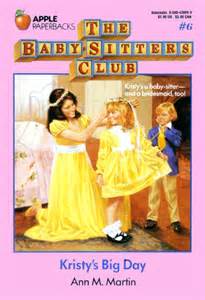
I picked up the next installment of The Babysitters Club, Kristy’s Big Day, and my heart sunk when I started reading it. Ann M. Martin had stole my idea! thI decided then and there that all the good ideas had been written about. What was the point of writing a story if others had already told the same one? I decided I could never be a writer. This whole episode is documented in my dramatic pre-teen journals.

I stopped writing all the stories I had spent so much time on, but of course, I did not stop reading. As I read more and more, I became TOTALLY convinced that I would never be able to be a writer. I would never be able to do what they could do.

Writing takes courage and perseverance and patience and TALENT.

Damn, I still want to be a writer.

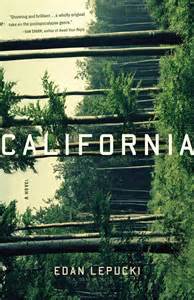
I read about California by Edan Lepucki last year (I posted about it here) and I was green with envy because she had taken  an idea I had been playing with in my head and she had turned it into an actual book. California, dystopic, wilderness, love – all the necessary ingredients for a good book. However, this book just worked okay for me, I did not love it.

There has been so much hype around  the book, on Colbert Report, etc. A LOT to live up to.

th

The good things about the book: Beautiful, gorgeous cover. Believable moments as humanity has reached a breaking point, but is not completely broken yet (like in other dystopian books). Good, well-developed, flawed characters. Some great lines and I like the ideas that the book is trying to explore. The feeling of escaping to the wilderness. “This was one of the things he loved about life out here. The space to consider questions. Even if he sometimes longed for mindless diversions, mostly he was grateful for the silence, the time”

The bad things about it: Stupid coincidences. Sloppy plot development. Dumb decisions.

I stayed up late to finish the book. But overall, it was not my cup of tea. I may have to write my own version of it.

For a good California dystopic read, I recommend The Age of Miracles by Karen Walker Thomas.

Another bummer read was Tom Robbins “autobiography” Tibetan Peach Pie. Boring. Not that interesting. He comes across as a little creepy. No matter what, Jitterbug Perfume will always, always remain one of my favorite stories.

The final bummer read is Delicious by Ruth Reichl. I hope you have read Comfort Me with Apples and Tender at the Bone. Reichl writes food memoirs like no one else (except maybe Anthony Bourdain, but his are totally different than hers). Delicious is her first piece of fiction. I finished it, but it was not 1/2 as good as her memoirs. Which is probably a good thing, because it means her actual life is more interesting than fiction. I wanted more descriptions of recipes and food. The character were boring. It was fine…meh.

My 6 month long good reading streak had to end sooner or later. Two days ago I picked up a huge haul at the library, and I think I am about to start another good streak. I just finished listening to Cuckoo’s Calling by Robert Galbraith (aka JK Rowling) on my commute – highly recommended. Right now, I am listening to The Storied Life of AJ Fikrey by Gabrielle Zevin – fantastic! Plus, I just bought a cookbook, Salad Samurai by Terry Hope Romero, and all the recipes that I have made from it have been perfect for the hot weather.

I’ve had another idea in my head for the last few months about what I want to write about. I have characters, but I need a plot. Maybe I’ll be able to get it out of my head and create something, or maybe I’ll just let it stay in my head where it can’t be judged and no one can ever say that it was a “bummer” read.

READ: And the Dark Sacred Night by Julia Glass + a few more

Julia Glass published her debut novel “Three Junes” in 2002 and, according to my book journal, I read it at the beginning of 2004. In the entry for it I have 4 stars (the highest possible), and I wrote, “Astounding! Why didn’t I write this? Fenno!!” Obviously, I loved it.

I read “Three Junes” over 10 years ago, but it feels like just yesterday that I was immersed in the lives of the McLeod family. Glass creates vivid, complex characters and it was hard to leave them when I finished the last page. Glass gives her readers a gift with “And the Dark Sacred Night” because she lets us in on what happened to some of the characters after “Three Junes” ended. The characters lives always go on…but most of the time us readers are left to wonder how it all really turned out.

Glass presents every day normal life with its beauty & sadness & confusion & love. She captures little nuances of the characters that make them feel like you have actually met in person. Her books usually switch around narrators which helps capture all the different viewpoints of people at different points in their lives. This narrative masterfully switches between the lives of Daphne, Kit, Jasper, Lucinda, and Fenno. The heart of the book is the story of Kit searching for his unknown father. As he searches, Glass explores what it means to make your own family and the profound impact that people who enter our lives for a very short amount of time can have.

If you haven’t read “Three Junes” by Julia Glass, read it before picking up “And the Dark Sacred Night” (not necessary, but it will be even more enjoyable that way). Together, they are perfect summer/vacation reading. Big, juicy, well-written novels that will immerse you in the tangled imperfect love that families of all kinds have.

I’ve been reading a lot the last few weeks. All the books have been good, and should be added to your list. What a luxury to do so much reading.

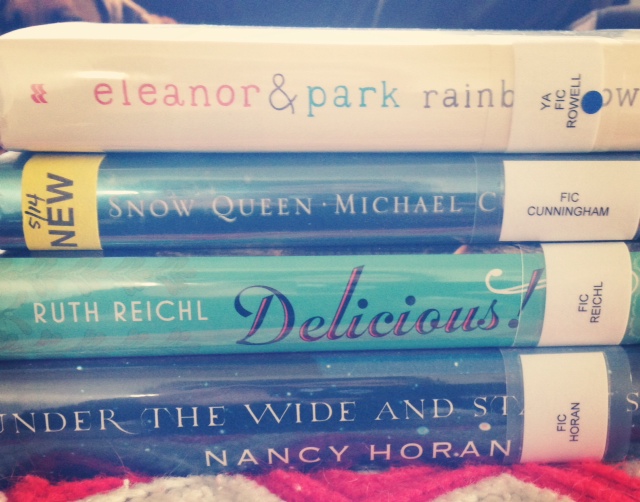
I devoured “Eleanor and Park” by Rainbow Rowell in about 2 hours. A young adult love story about 2 teenagers that is set in 1986 when mixed tapes were the most amazing gift ever. If you’ve read the book, I know you loved Park’s Dad! Fun, fast read. I’m glad that teenagers have books like this to read.

I also just finished “Under the Wide and Starry Sky” by Nancy Horan. The book is not as good as “Loving Frank” but it is still a worthwhile read. Fanny, the wife of Robert Louis Stevenson (author of “Jekyll and Hyde” and “Treasure Island”) is the central character in this historical fiction. A rule-breaker and a fearless female who divorced her first husband and traveled all alone to Europe with 3 children to pursue art in the 1800’s. The life that she and Stevenson led was extraordinary. They traveled all over the world searching for a place that would be a good habitat for Stevenson’s consumptive lungs.

At one point Stevenson is homesick for his native Scotland, “How bitterly ironic to be surrounded by palm trees, flying foxes, sweet-smelling gardenias, red and yellow fruit doves. And what do I see at every turn? My gray-pigeoned homeland.” When I read that line I was having massive homesickness for my family. It’s never easy wanting to be in two places at once, I can’t imagine what it must have been like before airplanes, FaceTime, and texting.

Another book I just read is “The Snow Queen” by Michael Cunningham. It is hard for me to describe how the writing of Michael Cunningham touches me. I love his sentences. I love the beauty of the ugly worlds he often describes. His books are like huge poems that I want to re-read because there are so many things that I feel like I missed. He writes simple sentences like, “People are more than you think they are. And they’re less, as well. The trick lies in negotiating your way between the two.” And then writes big, huge, gorgeous run-on sentences like,

 The young couple is, it suddenly seems, what Beth came outside to see. She can’t of course know what troubles may beset them, or what troubles await, but she’s satisfied by the fleeting apparition of two young people who are doing fine, right now; who have each other to laugh with, to hold hands with; who can thoughtlessly pass between them the simplicity of youth, of love, of a night that must, for them, promise an endless strand of nights, a world that offers even more than they’d hoped for; that’s given them this snow blown street and the promise of home, soon, as if love and shelter were the simplest things in the world.

“The Snow Queen” explores the interdependency of siblings, middle-age, and losing people that we love way too soon. This is not an easy read, but I think you should still pick it up and give it a try.

Library Haul

Also, I just finished listening to “Sarah’s Key” by Tatiana De Rosney. Listening to this powerful book about the Vel D’Hiv roundup of Jews in Paris coincided with a visit I took to the Holocaust Museum in Washington DC. We are a horrible species in so many ways.

I am listening to “The Invention of Wings” by Sue Monk Kidd (an Oprah pick!)- all of sudden my commute has become one of the highlights of my day. The narrators in this audio version are spectacular. I feel like I am in the deep South in the early 1800’s. Both of these audio books have made me think a lot about what I would do if my comfortable life was on the line. I hope I would be brave and do the right thing.

If you are looking for a book to read in July, maybe add “California” to your list. Here’s the first chapter. It comes out on July 8th, I’ve been looking forward to it since December.


READ: This is the Story of a Happy Marriage by Ann Patchett

About 13 years ago I read “Bel Canto” by Ann Patchett. I did not like it very much, although I can’t remember why. At some point I need to go back and re-read it because everyone else I know who read it loves it. A few years later I read an interview with her, and I thought that she sounded like someone I wanted to be friends with, so even though I didn’t like “Bel Canto,” I decided to go back and read her first book “The Patron Saint of Liars.” I am so glad I gave her another try. I also loved “Truth and Beauty” and “Run” – and my esteem for her continues to grow.

Her latest publication “This is the Story of A Happy Marriage” is a collection of 22 personal essays that were published in OutsideGourmet, Atlantic Monthly, Harpers, NY York Times, and more. Every single story in this book is a gem. She writes about writing, marriage, divorce, the slow death of her grandmother, dogs, owning a bookstore, her love of a nun, Nashville, trying out for the policy academy, opera, and censorship. She obviously thought very carefully about what stories to include in this collection because not one of them is a dud. They are the kind of stories that you could read over and over. Each one of them spoke to me.

In my favorite essay in the collection, “The Getaway Car: A Practical Memoir about Writing and Life,” Patchett discusses her road to getting published and how she has supported herself as a writer since she graduated from college. She dispenses so much honest, down-to-earth, practical information in this essay. Part of me has always wished that I had applied for an M.F.A. program instead of getting an MA in English, but she confirmed my practical decision (where we went into no debt for my degree). She writes: “my most empathetic piece of advice regarding whether or not to attend an M.F.A program has to do with money: no one should go into debt to study creative writing. It’s simply not worth it. Do not think of it as an investment in yourself that you’ll be able to recoup later on…” Patchett knows that writing requires work, talent, AND luck.

Patchett is friends with Elizabeth Gilbert, which is pretty cool. She loves dogs, which is even better. But, perhaps the most awesome part about her is that she OWNS a bookstore. When all of the bookstores in Nashville closed, Patchett and a business partner opened a small independent bookstore. She writes blog posts on the bookstore webpage and they are full of great reading recommendations. In the essay “The Bookstores Strikes Back” she describes the unpredictable way that she ended up opening a bookstore. I so appreciate how she reminds her readers to shop at stores that you truly support. She writes:

 But my luck has made me believe that changing the course of the corporate world is possible. Amazon doesn’t get to make all the decisions; the people can make them by how and where they spend their money. If what a bookstore offers matters to you then shop at a bookstore. If you feel that the experience of reading a book is valuable, then read a book. This is how we change the world: we grab hold of it. We change ourselves. 

Our money is our voice and that is how we can make a difference…which is why I don’t shop at Walmart.

Random, surprising fact I learned reading these essays – Patchett had a relationship with David Foster Wallace. He got around…Ann Patchett, Mary Karr, Elizabeth Wurtzel. I just finished reading about the Karr/Wallace relationship in “Lit” and Patchett (briefly) describes her relationship with him in “This is the Story of a Happy Marriage.” Wallace’s essay “This is Water” remains one of the best things I have ever read, but whenever I read descriptions about him he sounds like someone I would not want to be around.

Odds and Ends:

  • If you listen to podcasts make sure to check out the interview that Ann Patchett did with Teri Gross on Fresh Air.
  •  I think I may be the only person on the planet who did not read the Harry Potter series. Not sure why I never read them…Last week, I finished listening to JK Rowling’s novel “The Casual Vacancy” on CD. It is full of miserable people, set in the countryside of England, and will keep you turning the pages to see what happens next.
  • For fun reading about authors check out the Daily Beast’s How I Write series. Super fun and interesting facts about all the writers I love. Margaret Atwood and Barbara Kingsolver are my 2 favorites interviews…of course.

READ: The Museum of Extraordinary Things by Alice Hoffman

No one writes a love story like Alice Hoffman.

I have never been disappointed in an Alice Hoffman book. She is an extremely prolific story teller who has published books since she was in early 20’s. I have read and enjoyed EACH and EVERY one of her stories. They remind me of the magic and beauty in our world.  “Blackbird House,” ” The Dovekeepers,” and “Practical Magic” are essential reads.

In the “The Museum of Extraordinary Things” Hoffman creates yet another magical fairy tale. The novel takes place in Brooklyn in 1911 when the city was undergoing massive transformations. The novel weaves real events into the narrative with the Dreamland Amusement Park and the horrifying Triangle Shirtwaist Fire. These provide the backdrop to the stories of the two narrators – Coralie and Eddie. Both of these lost souls are searching for happiness after years of disappointment and loneliness. They are both motherless, have difficult relations with their fathers (for very different reasons), and are mentored by people who are outcasts to society.

Hoffman uses powerful themes and images in her work that contribute to the magical realism of her writing. In this book she plays with many opposing ideas like Fire/Water, Darkness/Light, Rich/Poor, Religious/Atheist, Normal/”Abnormal”, Entertainment/Exploitation. The imagery adds to the spell that her words have on readers. Pay attention to the many ways she utilizes animals throughout the story –  Fish, Dogs, Birds, Tortoise, Wolves. Compassionate practices towards animals contrast with the inhumane nature of labor practices for immigrants and “freaks.” The characters who are affiliated with animals are the “good guys” in the story.

Scenery and setting are key to this novel. Hoffman writes in a way that allows her readers to smell and feel everything. While I was reading this book I had dreams about the museum, the Hudson River, the forests of Ukraine, and Eddie’s carriage house. Hoffman does not write paragraphs and paragraphs of description, instead she has the power to create a sense of place with just a few well-chosen words.

Overall, the book is about the transforming power of love. Good love overcomes misunderstandings and evil. It is everything. One of the characters says about his wife who died shortly after they were married, “I’ll tell you this, a day with with her was better than a life without her…I wouldn’t mind being haunted. I’d be happy about it.” “The Museum of Extraordinary Things” enchants and delights on every page.

Authors have started releasing short youtube videos for their books. Elizabeth Gilbert did it for “The Signature of All Things,” and I noticed that Hoffman did it for this book. Kind of weird. Kind of interesting. Must be a new marketing tool that publishers are using…

In other Hoffman news, I read “The Dovekeepers” is being made into a mini-series that will be released in 2015. It will be on CBS – I’d be much more excited if it was HBO or Showtime, but I’ll still watch it.

Also, I blogged a few months ago about the 21-Day Oprah/Deepak Meditation Challenge. A new challenge, Find Your Flow, starts on MONDAY, April 14th. Register for it here!

READ: We Are All Completely Beside Ourselves by Karen Joy Fowler

I have a membership to the San Diego Zoo that I bought when my niece and nephew were in town last summer. The zoo is in Balboa Park, one of my favorite spots in town, and it is an incredible space with lush greenery, beautiful flowers and plants, and a wide variety of awesome animals.

In spite of all the positives I listed – I’m done with zoos. For good.

Every time I leave I feel horrible and haunted by all the sentient beings that are in their enclosures being stared at by an ever-changing group of visitors. I’ve tried to talk myself into liking the zoo, after all, the animals may have a better chance of surviving at the zoo than they would in their natural habitats that are being decimated by our destruction of the environment. But I am done trying to fool myself. Whenever I look at the animals I see all the similarities between them and me. They feel pain, pleasure, hunger, excitement, fear, compassion, and yes, they  share the most important quality that humans have – love. Check out the love in this video that was just released by the San Diego Zoo of a momma gorilla being reunited with her baby.

My sincere hope is that this momma gorilla and her baby are never separated because the San Diego Zoo decides to sell one of them to another zoo or park. When watching videos like this it is important to remember that zoos are breeding grounds where families are often separated.

I am familiar with the argument that zoos are good for animals and that they educate people. But in reality, they reinforce humans dominance over animals and we talk ourselves into thinking that zoos are good for animals. Much like we reassure ourselves that it is acceptable to eat some animals and not others.

The hardest part for me at zoos has always been the gorillas and chimpanzees because it is like I am looking in the mirror. Chimps are the closest relative to humans – Karen Joy Fowler’s spectacular novel “We Are All Completely Beside Ourselves” explores our similarity. I read this book awhile ago, but I didn’t know how to write about it without giving away the “surprise.” Who wants to be the spoiler? Barbara Kingsolver (my favorite author!) wrote an amazing review of this book in the NY Times, and in it she gives the “surprise” away because  it does not detract from the power and message of the book.

For the first 100 pages it is not obvious that a chimp is in the novel, because she is referred to over and over again as the long-lost sister of the narrator, Rosemary. The sister of Rosemary is a trouble-making, antic-loving chimpanzee named Fern.

Rosemary and Fern are a part of an experiment where they are raised together to see what characteristics they share, etc. Fern is raised in a human family and treated like the other two children, Rosemary and Lowell Cooke. Tight familial bonds are created – of course those bonds include love, friendship, sibling rivalry, and misunderstandings. Since Rosemary is raised side by side with Fern, she develops “ape” like tendencies such as standing close to people, touching others a lot, and acting a little out of control. Rosemary and Fern mirror each other in many ways.

Fern leaves the Cooke family when she is 5 years old. Her departure creates a huge hole in the family that tears them apart. This novel explores family dynamics, while at the same time it scrutinizes the relationship between humans and animals.  At one point Lowell says about the way that we treat animals: “The world runs…on the fuel of this endless, fathomless misery. People know it, but they don’t mind what they don’t see. Make them look and they mind, but you’re the one they hate, because you’re the one who made them look.” Of course this statement is so, so true – we like to shoot the messenger instead of thinking about the message.

Fowler does not lecture or preach in this novel – she is way too much of an expert novelist to do that. Instead she weaves a subtle, powerful story with well-developed characters and an intense plot that involves the way our memories can play tricks on us. It is well-researched and is loosely based on a true story. I love that she challenges her reader to think about so many things that we try to not think about. At one point Rosemary says: “You might be shown the photos of the space chimps in their helmets, grinning from ear to ear, and you might feel an urge to tell the rest of your class that chimps grin like that only when they’re frightened, that no amount of time with humans will change it. Those happy-looking space chimps in those pictures are frankly terrified and maybe you just barely stop yourself from saying so.” We fool ourselves into thinking the chimp is having fun, just like we tell ourselves that animals like being in a zoo.

**********************************************************************************************

I have been obsessed with podcasts lately. I think people around me on the freeway think I am crazy because I am always laughing or crying in my car. If you get a chance, listen to two of my favorites:

Animal Sacrifice|This American Life – The story about dogs during WWII surprises and bewilders.

Space|Radio Lab – I’ve listened to this podcast at least 3x over the last 2 years. Anne Druyan gives a beautiful interview about her love for Carl Sagan. If, like me, you are obsessed with the TV show COSMOS this is a MUST listen.


READ: Jeannette Walls

My sister visited last week, and while she was here we went to a talk by Jeannette Walls at the Point Loma Nazarene Writer’s Symposium. Walls wrote the 2006 NY Times Best Selling memoir “The Glass Castle” – I feel like I may be the only person who hasn’t read it. She was gracious, warm, inspiring, and authentic in the discussion. I wanted to have a cup of coffee with her and keep the discussion going. Storytelling comes naturally for her, and the coolest part is that she knows that she has been given a beautiful gift.

Walls said a lot of things that resonated with me and I filled 4 pages in my notebook. She kept repeating that we don’t have perspective on our own story – because we are a part of the story we don’t realize the amazing stories that each of us have. Write it down, be honest, and a unique story will emerge. All stores are different because “People can agree on facts, but not how it happened.” Being honest liberated her.

Walls had a horrible, “wacky” childhood (as described in detail in “The Glass Castle”), however she is not bitter or broken. Her bad childhood put everything in perspective and she never takes her life, or a meal, for granted. The interviewer at the talk asked her if she had forgiven her parents, and Walls said that she did not need to forgive them. They did the best they could, and if she forgives, she sees herself as a victim. She chooses not to see herself as a victim. She said, “Love of education and self-esteem can get you through anything.” Her parents, with all of their faults, gave her those two things.

I felt like the discussion with her continued over the last week because I listened to her novel “The Silver Star,” on CD and she reads the story. I am not sure I would have liked the book if it was narrated by someone else. Since I had just been to her talk , I felt like she was in the car telling me a story while I drove on my commute. This is the first fiction novel by Walls, and she said in her talk that there were a lot of grains of truth in it.

The narrator of the story, Bean Holloday, reminded me of Scout from “To Kill A Mockingbird.” Bean is all spunk and sass. “The Silver Star” explores small town life, messed-up families, the bonds of sisters, and the potential dangers of standing up for what is right.

I am so excited about two books that are coming out that I am adding to this reading list.

  • My father-in-law introduced me to Tom Robbins and “Jitterbug Perfume” when I was 18. I LOVED that book, I still do. There were only three things I liked about my freshman year of college at Michigan State University: my roommate, working at the Wharton Center and seeing free plays, and reading ALL of Robbins books over and over. I highlighted the crap out of those books. Robbins has a memoir coming out called: Tibetan Peach Pie: A True Account of  an Imaginative Life. I can’t wait to read it!
  • The final book in the All Souls Trilogy by Deborah Harkness comes out in a few months. It is called The Book of Life, and if you have not started the series and you like believable stories about vampires and witches you should start reading now. The series reminds me of Anne Rice’s Mayfair Witch Series – which I think is her best work.

READ: The Fault in our Stars by John Green

This morning I read the last 100 pages of “The Fault In Our Stars” by John Green in one sitting. Then I cried my face off for an hour. I got up to do the dishes, tears still came. I went to yoga, sat down on my mat, and the tears continued to leak out of my eyes. I don’t think I will be able to see the movie, which comes out in June, without a box of kleenex.

I didn’t want to read this book, even though it was on all the must-read lists of 2012, because over and over I heard that it was a tear-jerker and super sad. It seemed like the book would be a big, fat cliche. I am so glad that I put it on my library list (it took me almost 5 months to get it – I was #675 on the reserve list). The reason I finally decided to read it was the title. “The Fault In Our Stars” is a great title and it brings all kinds of thoughts and images to my mind (my favorite book title of all time is “Slouching Towards Bethlehem” by Joan Didion, which is actually a phrase by Yeats). The reason for the name of the title is revealed in the book, and it made me love the title even more. I thought I knew how the book would go before I even read it, instead the irreverent writing and unpredictable storyline surprised me. Green perfectly captures being a teenager, and a person, in a f#@%ed up, unfair situation.

I am sure you have heard the basic premise of this book: two teenagers meet in a kids-with-cancer support group and they fall in love. The narrator, Hazel Grace, is a 16 year old who will make you adore her before the end of the first chapter. Hazel has terminal cancer. She encounters Augustus at the cancer support meeting, and immediately they start a snappy dialogue that they both don’t want to ever end.

They fall in love fast, after all, Hazel has terminal cancer and does not know how much longer she will live. In a memorable scene Augustus says, “I’m in love with you, and I know love is just a shout out into the void, and that oblivion is inevitable, and that we are all doomed and that there will come a day when all of our labor is returned to dust, and I know the sun will swallow the only earth we’ll ever have, and I am in love with you.” And that is the kind of dazzling words and images that make this book so good. A version of this speech is in the movie preview above.

Everyone that knows me knows that I get so excited about what I am reading, and I want to share it with everyone (which is part of the reason I started this blog). Hazel describes this trait that we share perfectly, “Sometimes you read a book and it fills you with this weird evangelical zeal, and you become convinced that the shattered world will never be put back together unless and until all living humans read the book.” I feel that way about so much that I read!

I’ll get my evangelical thing going…You should read “The Fault In Our Stars.” It will break your heart, and it will remind you that never have enough time, no matter how long you live. Everyday, normal life is awesome. Love is a gift. Nothing is more important than the current moment. We are all made of stars. I am writing cliches now…

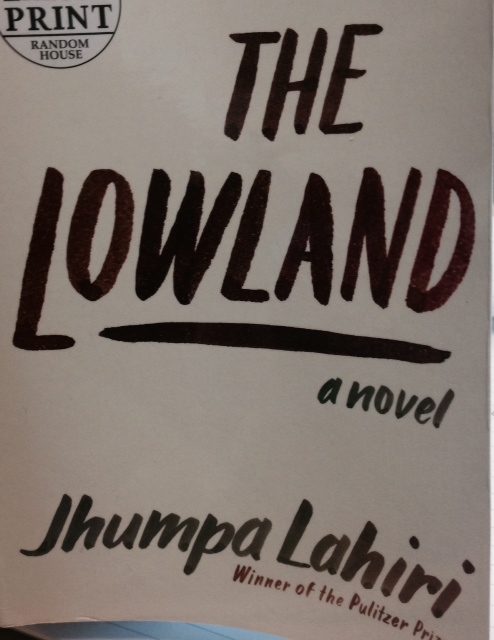
READ: The Lowland by Jhumpa Lahiri

One of the best parts of working at a university is the library. Students are busy reading for class, so new releases are almost always available and I can check them out for 5 months. I picked up The Lowland by Jhumpa Lahiri about 2 months ago from Geisel Library, but it sat, untouched, in a pile of books in my bedroom. Then I received an email from the library telling me that I had to return it within five days because it had been requested…I can’t stand returning my library books late, so the email prompted me to pick it up to read the first page, and I had no problem finishing it in the five days that I had left to read it.

UCSD Geisel Library
UCSD Geisel Library

Surprisingly, “The Lowland” is the first book I have read by Lahiri. I have heard all good things, but for some reason I haven’t read her work. After reading this, I will definitely be checking out her previous novels. “The Lowland” covers four generations of an Indian family whose lives go from India to Rhode Island to California. The chapters rotate narrators, and the literary device helps this novel explore the theme of the big, gigantic pain of secrets.

Subhash and Udayan are brothers growing up in India with a close bond, but as they enter college they start to separate, especially when Udayan becomes involved in the Naxalite movement (which I had never heard about prior to reading this). Subhash moves to the United States to complete his education, while Udayan stays in India and marries a woman named Gauri. Tragedy strikes, and the lives of these characters intersect in a way that none of them expected.

My favorite narrator in the the book is the somewhat unsympathetic character of Gauri. Her passion for philosophy leads to beautiful passages about time. Gauri has “an acute awareness of time, of the future looming, accelerating. The baby’s lifetime, so scant, already outdistancing and outpacing her own. This was the logic of parenthood.”

When Gauri talks about her daughter, it reminded me of so many children who are trying to understand the baffling, incomprehensible passage of time. In particular, I remember my sister, Julie, doing this: “At four Bela was developing a memory. The word yesterday entered her vocabulary, though its meaning was elastic, synonomous with whatever was no longer the case. The past collapsed, in no particular order, contained by a single word…Bela’s yesterday was a receptacle for anything her mind stored. Any experience or impression that had come before. Her memory was brief, its contents limited. Lacking chronology, randomly rearranged”

photo-11

Time helps heal some wounds in the book, however the characters feel overwhelmed by the inescapable past. It is always there. The secrets spread apart the family and cause a lot of pain. Lahiri tells a satisfying, deep, multicultural story that beautifully comes together and sticks with the reader.

On a different note, I have rediscovered my love for audio books. Over the last few weeks I’ve listened to “Fin and Lady” by Cathleen Schine, “2001: A Space Odyssey” by Arthur C. Clarke, and “Lit” by Mary Karr. They have all been great, escapist audio narratives, especially “Lit”. Karr is a master memoirist who narrates her audio book with her southern accent and lots of emotion. The book explores her descent into alcoholism and the years it took her to grapple with her demons. Listening to these books on CD makes my crappy commute so much better, in fact, some days I am glad to be stuck in a traffic jam on the 5.

READ: The Signature of All Things by Elizabeth Gilbert

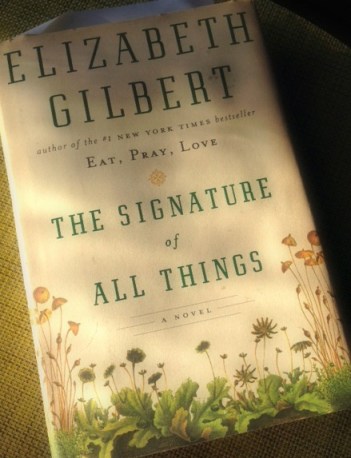
I stayed up late the other night finishing “The Signature of All Things” by Elizabeth Gilbert because I wanted to see how it all turned out. “I want to see how everything is going to turn out” is the signature phrase of my Great-Aunt Nancy, and it fits her to a tee. Her curiosity has played a strong part in keeping her alive, and sharp, into her 90’s. The main character in “The Signature of All Things,” Alma Whitaker, has that same inquisitive trait (she reminds me in many ways of my Great-Aunt Nanc) and the story of her life makes for a fantastic read. I loved this book. It is an essential read.

I learned a lot while I read “The Signature of All Things,” but I didn’t realize it until I finished because I became so lost in the narrative. Gilbert masterfully provides her readers with science and history lessons, all seen through the eyes of Alma, one of the most fully developed characters I have encountered. Curiosity and a thirst for knowledge sustains us. Gilbert’s narrative demonstrates that searching for answers, asking questions, and looking for meaning are all human traits that are absolute gifts (most of the time).

The Signature of All Things

Alma Whitaker is born in 1800 into a privileged life on an estate in Pennsylvania. Her father and mother have high expectations for Alma’s behavior and attitude, so every moment of the day is filled up with opportunities for her to learn and experiment. The house she grows up in has a steady stream of esteemed visitors, who must be interesting, articulate, and intelligent to meet the intellectual demands of Alma’s father. One of my favorites scenes in the book occurs when an astronomer creates a solar system at a party held outdoors. I don’t want to spoil the scene for people who haven’t read it so I won’t describe it in detail, but at one point Alma becomes a comet. Gilbert writes:

Astonishingly, at some point, a sputtering torch was thrust into her hands. Alma did not see who gave it to her. She had never before been entrusted with fire. The torch spit sparked and sent chunks of flaming tar spinning into the air behind her as she bolted across the cosmos-the only body in the heavens who was not held to a strict elliptical path.

Nobody stopped her.

She was a comet.

She did not know that she was not flying.

Her knowledge gives her confidence, and one of the characters tells her that “The entirety of your being is reassuring, Alma.” As a woman in the 19th century her opportunities were limited, but she makes the best of her circumstances and eventually her life leads her to places and to people she would never have imagined. Alma does not have a perfect life, but it is a full, meaningful life. Really, what more can we ask for?

More than anything Alma likes to study and theorize. She devises theories of time and thinks of them in four groups: Human Time, Geological Time, Divine Time, Moss Time. Alma thinks, “The most striking characteristic of Human Time, however, is that it moved with such amazing quickness. It was a snap of the finger across the universe…She was a mere blink of existence, as was everyone else.” Her descriptions of all the Times are beautiful and thought-provoking.

My favorite line of the book, which brought tears to my eyes because I thought of my Great-Aunt Nanc, is when Gilbert writes that Alma, “…still wanted to see what happened next, as much as ever.” Because we all live in Human Time, as Alma would say, we don’t get to see what happens next. We need to make the most of the time we have.

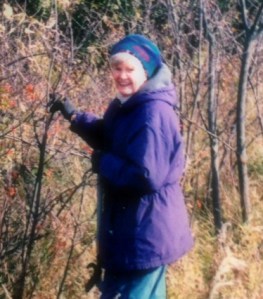
Aunt Nancy when she was about 85. She had just made us pull over when we were driving so she could look at plants growing on the side of the road.
Aunt Nancy at about 85 years old. She had just made us pull over when we were driving so she could look at plants growing on the side of the road.