READ: Mermaids in Paradise by Lydia Millet

I’ve had a preoccupation with nuclear bombs since third grade. It amazes me that all of us go about our everyday, normal lives with these atrocities in our midst. I could go on and on about my obsession with all things nuclear. I’ll save it for another time…There are so many books that I love that address nukes, but one of my very favorites is Lydia Millet’s “O Pure and Radiant Heart,” which brings Oppenheimer, Fermi, and Szilard to the present day so they can see the monster that they created. Millet plays with the absurd in her novels, and they are all political, hilarious, and thought-provoking.

FullSizeRender-7In “Mermaids in Paradise” her dark, biting humor had me laughing out loud and smirking on almost every page. The novel’s premise is the Caribbean honeymoon trip of a normal, boring American couple that takes a weird turn when they discover mermaids. Yes, mermaids. You never know, they could be out there.

The husband, Chip, is a happy, all around good guy with an obsession with Midwesterners, gaming, and fantasy. The wife, Deb, narrates the story. She’s a bit of a sour-puss who gives wry observations like the following about wedding planning with her mother in law:

“I told her no favors, since Chip and I had passed beyond that phase. We were adults, I told her calmly, but firmly: when we attended a party we didn’t expect to go home with sparkle-filled bouncy balls or a handful of Tootsie Pops…No, we were perfectly pleased to leave a party empty-handed, our blood alcohol content somewhere above .08.”

and

“If a man like Chip can emerge sane and whole from eighteen formative years with a Nurse Ratched harpy, there’s hope of redemption for each and every one of us. There’s hope the sun may not burn out after all, some billions of years hence, transforming into a giant fireball that obliterates the planet.”

When Chip and Deb get to their honeymoon, it starts to get weird, and hilarious. They meet a motley crew of people, and together they try to save the mermaids from the claws of capitalism that are absolutely everywhere in our world. “Mermaids in Paradise” examines issues like extinction, exploitation, and technology.

Deb thinks: “What was their problem? Our problem, as a race…It seemed to me the virtual world was even worse that the real one, when it came to humanity…Here we sat at civilizations technological peak, and what we chose to do on that shining pinnacle was hate each other’s guts.”

I love the ending. It left me feeling a little hopeless and like people are generally assholes, but it also reminded me of the magic and beauty that surrounds us every day.

 **************************************************************

I just finished another irreverent novel called “The Wallcreeper” by Nell Zink. It is a dark, twisted book that is FULL of zippy one-liners. Thru the lens of a parasitic woman who attaches herself to men, the book explores eco-terrorism, marriage, and the search for meaning.

Two nights ago I stayed up until 2:00 in the morning to read “What Comes Next and How to Like It” by Abigail Thomas. This memoir is so honest that reading parts of it are uncomfortable. I felt like a voyeur that was snooping on her family. Thomas writes about mortality, being hurt by those we love the very most, forgiveness, addictions, and complicated family dynamics. She writes truth.

Thomas gives possibly the best advice EVER: “Forget career, forget the future, forget existential worries, just get yourselves a couple of dogs, and everything will be all right.” Yup, that about sums it up. Also I love how she captures the mother /daughter relationship over and over. She describes something to her daughter, who responds, “Yes Mom, I know. Your memories are my memories.” 

For another view into someone’s life that feels a little uncomfortable, but is so, so beautiful listen to the podcast “The Living Room.” Sob!!

READ: The Secret History of Wonder Women by Jill Lepore

The RadioLab podcasts consistently amaze me. This week the episodes Fu-Go and Los Frikis had me saying “Holy Shit” over and over again. If I tell you to much I’ll spoil them…the bare details are that Fu-Go reveals a crazy story about the Japanese during WWII, and Los Frikis tells a story about Cuba, punk, and HIV. These true stories are secret histories that will astound you.

Hidden truths are so much juicier and interesting than the sanitized versions of history most of us know. I loved the shocking, fun, and hilarious details in Jill Lepore’s book, “The Secret History of Wonder Women.” Lepore wrote this book with obvious delight. It is an inherently readable history that reads like a juicy, unputdownable (is that a word?) novel. I know doing all of this research must have been really hard and time-consuming, but it seems like Lepore is having a lot of fun with the material.

24BOOK-master495-v3

The main character in the book is William Marston, the creator of Wonder Woman (and also the lie detector test). Marston was a feminist, a polygamist, a bohemian, a swindler, and an academic. All of the diverse experiences in his life led him to the creation of Wonder Women. The whips, chains, and bondage that are in every single episode of the early comics are partly fetish, but Marston kept them in there to show a strong woman breaking the bonds that were imposed by a male-dominated society.

Lepore goes into great details on the Women’s Rights movement, particularly in regards to Margaret Sanger, the creator of Planned Parenthood. Sanger had connections to Marston through Olive Byrne, the woman who lived with Marston and his wife and bore his children. I’m a little ashamed to admit I had never heard about Ethel Byrne, Margaret’s sister and Olive’s mother. Lots of brave people have contributed to the “liberation” of women. We still have a long way to go  – reading about inspirational women who paved the way for all of us is an important reminder that we need to keep demanding changes because we do not want to allow any of the hard work that all of these women (and men) did go to waste.

Lepore adds great anecdotes to the book which reveal where certain characters in Wonder Women came from. She also provides interesting details about the origins of comics (Read Chabon’s “The Amazing Adventures of Kavalier and Clay” for a great fictionalized version of this). The book includes a fantastic collection of photos, sketches, and snippets of the original comics. Overall, reading this book makes me want to study history all the time – because there are so many great hidden histories out there.

If you think all of this sounds interesting, but don’t want to read the entire book, check out this article in the New Yorker that Lepore wrote. She writes:

“Superman owes a debt to science fiction, Batman to the hardboiled detective. Wonder Woman’s debt is to feminism. She’s the missing link in a chain of events that begins with the woman-suffrage campaigns of the nineteen-tens and ends with the troubled place of feminism a century later. Wonder Woman is so hard to put on film because the fight for women’s rights has gone so badly.”

******************************************************************

Words of Wisdom an excerpt from Wendell Berry’s new book.

These Tofu Bahn Mi Sandwiches are AMAZING. We’ve made them 3x. Delicious.

I read “Brown Girl Dreaming” by Jacqueline Woodson in a few hours last weekend. It won the National Book Award and should be required reading for all 4th and 5th graders. It’s a coming of age book set in the 60’s and 70’s told in a lyrical, rhythmic pattern. Unique, powerful, beautiful.

I also just finished the latest Oprah book club selection, “Ruby” by Cynthia Bond. Of course, I loved the title, but I didn’t love the book. It is brutal and rough and left me disgusted with the human race. Bond uses magical realism and she writes beautifully, but this is a hard, disturbing novel. Be prepared to witness incredible evil if you read this!

Lauren Groff, who wrote one of the BEST books ever, “Arcadia,” has a new book, called “Fates and Furies” coming out in September. If you have not read “Arcadia,” add it to the top of your book pile!

Can’t stop thinking about the poem “Mysteries, Yes” by Mary Oliver. In particular, these lines:

Let me keep my distance, always, from those
who think they have the answers.

Let me keep company always with those who say
“Look!” and laugh in astonishment,
and bow their heads.

READ: The Empathy Exams by Leslie Jamison

The honest, complicated essays in the “The Empathy Exams” by Leslie Jamison remind me of a combination of Gilbert and Gubar’s “The Madwoman in the Attic,” Joan Didion, and Elizabeth Wurtzel. The collection reads like a really great issue of the New Yorker. Jamison delves into a wide variety of subjects that include: medical acting, Morgellons disease, abortion, West Memphis three, Tijuana, prison, crazy-ass torturous marathons, saccharine, heartbreak. You should buy this book because it is best in small doses, and each essay gets better when it is read a 2nd, or a 3rd time.

IMG_3718The first essay, “The Empathy Exams,” and the last one, “Grand Unified Theory of Female Pain” are the standouts in the collection. The title story explores Jamison’s job as an actor who pretends to have a wide variety of ailments for medical students. More than anything, these medical students need to learn empathy and, really, is empathy teachable? Jamison weaves her experiences as a real patient with anecdotes from her acting job. The essay beautifully captures how hard it can be to have empathy, and yet, the importance of it can NOT be dismissed.

The last essay probes the idea of the wounded female by invoking famous characters in literature, authors and memoirists, and popular culture. Periods, pregnancy, childbirth, rape, eating disorders…Jamison writes, “We don’t want anyone to feel sorry for us, but we miss the sympathy when it doesn’t come. Feeling sorry for ourselves has become a secret crime…” It is important to keep in mind, that the wounded female Jamison describes is mostly a certain kind of female – a youngish, middle-class, educated, white, American female (because that is what Jamison is). Her portrait is not entirely identifiable, but it strongly argues for an overarching plea for compassion – and that speaks to me. I really love this collection.

“Heading south down 1-79, I feel the border between Maryland and West Virginia as a smooth highway turning to sandpaper. The land is beautiful, really beautiful – endless lush forests, pristine and unblemished, countless shades of green on hills layered back into drifts of fog. I start thinking maybe coal mining is just a notion someone had about West Virginia; or something they like to talk about on NPR…because this place seems phenomenally unscarred, phenomenally pure.”

**************************************************************************

Last weekend, in one day, I devoured “A Three Dog Life” by Abigail Thomas. So, so good – I am surprised I just discovered her! Thomas reminds me of Anne Lamott, but calmer and less religious. In this memoir Thomas describes creating a life for herself after her husband is in a horrible accident and suffers brain damage. Guilt and regret are such hard emotions to get past, but Thomas keeps moving forward with the hand that she has been dealt.

We all have such crazy, beautiful, and often f-ed-up lives. Thomas captures this in an honest, immensely readable way. I read books and novels to escape reality, but I also read to learn how others navigate through the wonders and horrors of life. Thomas, with the assistance of her three dogs, creates a life for herself that is not what she anticipated, but nonetheless, it is a good life.

Thomas has a new memoir called “What Comes Next and How to Like It” that will be published  March 24, 2015. I already have it reserved at the library.

**************************************************************************

Check out the Dear Sugar Podcast with Cheryl Strayed. If you are a fan of Wild, you’ll love these hour-long discussions.

READ: Dept of Speculation by Jenny Ofill + More

In a poetry class at college the professor told all of us that he only read poems because he was too old to read long novels. He said he could get the same impact in a few verses, so why spend days or weeks reading one book. I did not understand him then, but I think I do now.

I will probably always love a long novel that sweeps me up and leaves me unable to do anything except lay on the couch and read, however, short prose becomes sweeter all the time. Jenny Ofill’s short, short novel (or novella?) “Dept of Speculation” is crushingly beautiful and I finished it in about an hour.

I don’t like stories about infidelity. They piss me off and are usually full of tired clichés. But I am so glad I gave this story a chance. Don’t let descriptions of this indescribable book stop you from reading it! “Dept of Speculation” reads like a writing experiment with unnamed characters, odd pacing, quotes and literary morsels, and shifts between points of view, but it all comes together to create a portrait of a life with all its icky quirks and horrible junctures and the beautiful, heart-stopping moments that sustain us.

This story about love, middle age, marriage, having a kid, being an artist, living in the city, anxiety, and then the tired old story about an infidelity is hard to explain, but it is a great literary experience. Ofill scatters literary references throughout – Rilke (who I have cherished since I was 21 when the poetry professor mentioned above assigned him), Keats, Yeats, Kafka, Herodotus, Berryman…she also weaves in scientific facts and snippets of stories. She relays the love story of Ann Druyan and Carl Sagan, I’ve heard Ann’s version of their romance on Radiolab, but of course, there is more to their story than just one version.

I experienced this novel twice – I read the book, and then I listened to it on CD, where the author reads it beautifully (I had them both reserved at the library, and they came in at the same time). I recommend listening to the audio version if possible. Either way you experience it, enjoy getting swept away in the beauty of her pacing and unique writing.

********************************************************************************************************

Another unique piece that I can’t stop thinking about is the movie “Boyhood.” I think I have told everyone to watch the movie. It made my heart hurt over and over again.

I’m sure you’ve heard the original premise of “Boyhood” – director Richard Linklater filmed the movie over 12 years with the same actors. An incredible feat considering the young boy in the movie was only 6 when filming started, he stuck with it over 12 years and remained a talented actor throughout. The movie is edited together so that it is a collection of little moments, and the only way to tell that time is passing is from the appearance of the actors, particularly the children. The soundtrack in the movie (which is fantastic!!) also helps viewers note the passing years.

There is not a lot of plot in the movie, instead it is a collection of all of the small snapshots of time, the tiny epiphanies that shape who we become. At the end, especially after a powerful moment between the mom and her son, viewers are left shattered by the fleetingness of time and our inability to fully appreciate all the beautiful, and sometimes horrible, things that shape our lives.

“Boyhood” hits close to home – the film portrays a normal American family, which is not a so-called traditional family. Like the children in the movie, my sisters and I have two parents who loved us and wanted the best for us, but they couldn’t stay together. My sisters and I have a unique bond because we experienced these moments together, although, of course, we each remember different moments and experiences. It’s okay, it’s not the end of the world when families separate (and then re-create), but it often creates complicated situations and it shapes who we become.

***************************************************************************************************

 Fun links:

Top 10 Food Books of 2014

13 World Food Predictions for 2015…it includes pot pesto – fun!

READ: The Book of Strange New Things by Michel Faber

I haven’t been able to concentrate on reading books the last few weeks. Every time I pick up a book I find myself distracted and antsy. That’s not normal for me. During the 2 weeks I had off for the holidays I read a total of one book, although I anticipated spending the entire break reading through a stack that I picked up from the library. Instead of reading, I’ve been watching movies and TV, reading blogs, and listening to podcasts and music.

The one book that I read over the holidays (mostly in front of a big fire in Idyllwild), “The Book of Strange New Things” by Michel Faber, made me think a lot, perhaps too much, so a self-imposed bookFullSizeRender-5 break may have been necessary.

One of my favorite books is “The Sparrow” by Mary Doria Russell. There are many things that I love about the book, but the BEST part about it is the exploration of religion (specifically Catholicism) and conversion in an alien species. Faber examines that same basic premise in his novel, and although it is not as powerful as Russell’s, his novel brings up philosophical questions and made me think a lot about the utter improbability of life.

At its heart “The Book of Strange New Things” explores the marriage of Bea and Peter. Peter is a recovering addict and pastor chosen by a secretive corporation to go on a mission to a different planet to teach an alien species about Jesus. His wife, Bea, remains on Earth because spouses are not allowed on the mission. They stay in contact via a form of email that Peter calls “epistles.” As the book begins their faith and marriage are strong and unshakeable…that all falters as Bea witnesses life on Earth falling apart and wonders where God is in all of the tragedy and chaos.

On the other side of the universe, Peter’s faith becomes reinforced. He becomes swept up in religion. He feels reinvigorated, he is making a real difference and he wants to share it. About a fellow human on the mission, he thinks: “She gave him a look he recognized very well, a look he’d seen on thousands of faces during his years as a pastor, a look that said: Nothing is worth getting excited about, everything is a disappointment. He would have to try to do something about that look, if he could, later.” Peter becomes caught up in complete religious fervor.

The dystopian reader in me found myself more interested in Bea’s story than Peter’s, but it is their collective story and the role of God that form the core of the novel. The book has eerie overtones, and it probably will bring up different philosophical questions for you, than it did for me. I was left at the end thinking of all the unanswerable questions. And I was left with a feeling that everything is so fragile, and at the same time, so much is miraculous.

********************************************************************************************

I finished The Southern Reach Trilogy by Jeff VanderMeer last week. All three short books, “Annihilation,” “Authority,” and “Acceptance,” came out in 2014 a few months apart. I don’t know how to talk about these weird books. I actually feel a little stupid trying to describe them…like a poem, the books left me with a feeling more than anything else. The covers are all gorgeous, I know that. The books, well the books made me feel nervous, undone, confused, tense, and on-edge. Reading them felt like I was lost in a painting. They possess a surreal beauty and the creepy effects of the book linger. Area X is not a place I will soon forget.  Sidenote: Jeff mentions me in this blog post 🙂

The Morning New Tournament of Books starts in a few weeks. I’ve added several nominees to my library list (including the trilogy by Elena Ferrante that keeps popping up everywhere) and I’ll be rooting on “Station Eleven” and “The Bone Clocks.” Follow them on Facebook for updates.

I’ve had a little cough and my studio was closed for about 10 days so I’ve been doing yoga at home more than usual. The classes at Yoga with Adrienne are free, fun, and have lots of variety. Check them out.

Eat: Noodle Bowl

A few years ago I made a bowl of miso broth with noodles as a fast, easy dinner when my brother-in-law visited us. He raved about it. I think he was really hungry, but there is always something comforting and filling about noodles in a yummy broth. I have no idea how I made that bowl a few years ago, but Joe, this recipe I’m sharing is for you…

Make the tofu first:

  • 1 TBSP sesame oilIMG_3493
  • 1 TBSP soy
  • 2 TBSP avocado or canola oil
  • a few dashes of rice vinegar or juice of one lime
  • 1 tsp turmeric or curry powder
  • sesame seeds

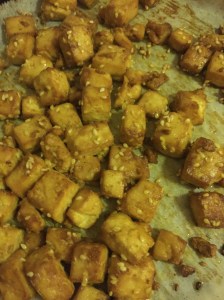
Slice 1 block of pressed tofu into bite size pieces. Marinate in the above for as long as possible (1 day is ideal, but 30 minutes works) and then bake at 450 for about 15 minutes. Using parchment paper makes clean up much easier. Move the tofu pieces around often – they are ready when they are a little crispy. This tofu is based on a recipe from an Indian cooking class I took a few years ago and it is YUMMY. I also use the tofu in curries and stir fries, make a big batch of it to use it in a few recipes.

When the tofu is ready, make the broth:

Saute the below in a soup pot for a few minutes.

  • 1 TBSP sesame oil
  • 2 garlic cloves, minced
  • 1 knob of fresh ginger, grated (I think of a knob as something the size of my thumbnail)
  • jalapeño or other spicy pepper, diced (optional – depending on the pepper it can make it really spicy)
  • Shitake Mushrooms, diced (optional, but highly recommended)
Then add:
  • 1 TBSP soy sauce or tamari
  • 1 TBSP honey (local, good honey not the cheap stuff)
  • 1 TBSP Srichacha (or more, or less)
  • 1 box veggie broth (my new favorite is Trader Joe’s Miso Ginger – delicious!!)
  • 1 TBSP miso

Mix together and simmer (don’t boil because of the miso) for about 5-7 minutes until it is hot and the flavors have melded. You may want to add some water to make more broth – taste and see what it needs. You can add water to dilute some of the flavor.

OTHER INGREDIENTS

  • Udon or Soba Noodles
  • Cilantro, diced (optional)
Cook noodles separate according to package directions. Don’t try to cook the noodles in the broth (I’ve tried it as a timesaver and it does not work). I usually cook the noodles before making the broth, and then put them aside. I make it in the same pot as I cook the broth so there are less pots to clean.
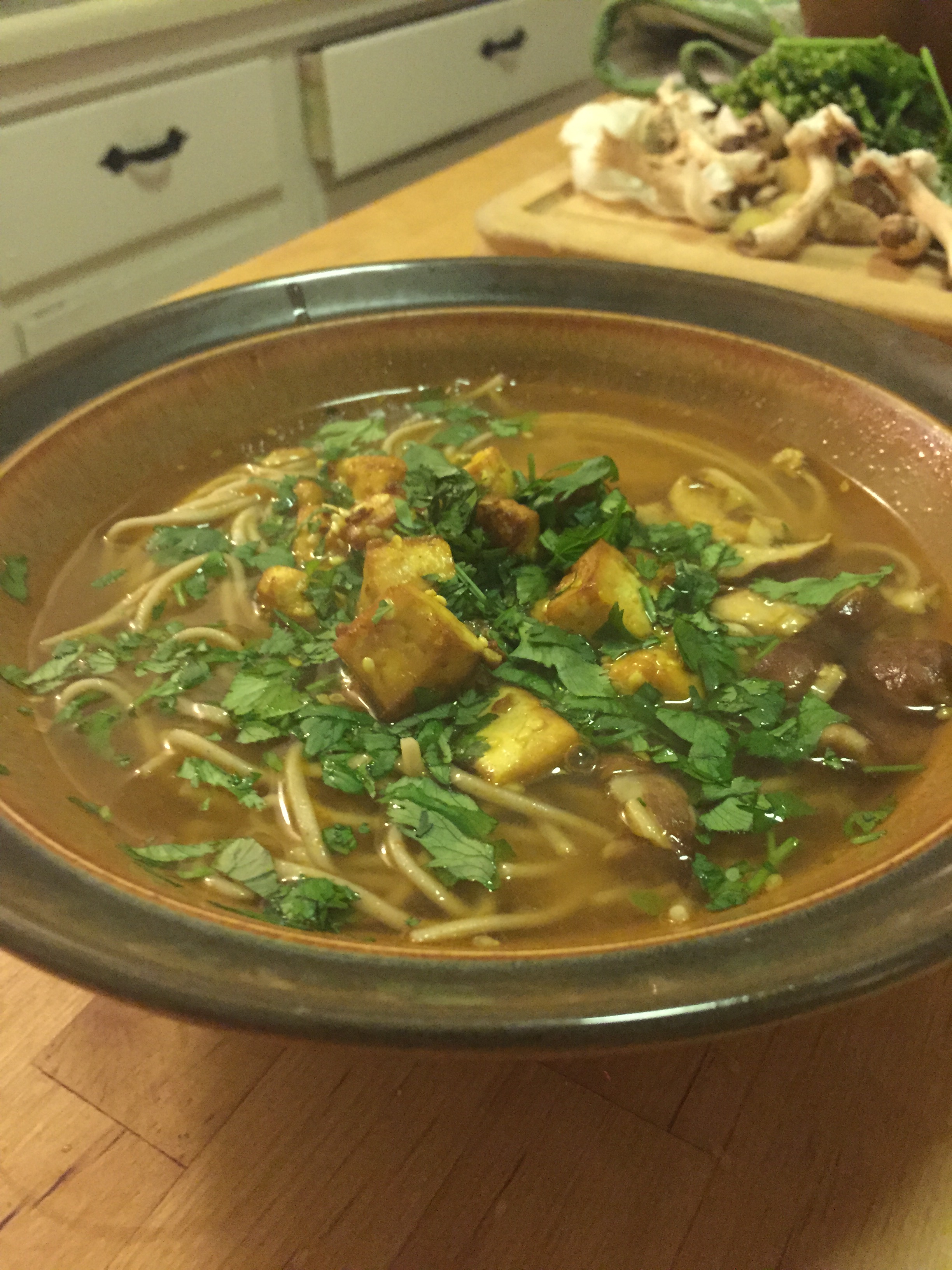
Then add lots of noodles & cooked tofu to bowl, and cover with the broth. Drizzle with lime and cilantro (if you have it).
 IMG_3498
Other things that I add to this have included: carrots (cut small), kale or other greens, lightly steamed broccoli, shelled edamame, and bean sprouts. The dinner is easily adaptable based on what you have in the house. This recipe is easy (my husband makes versions of it all the time), cheap, and flexible.
It requires lots and lots of slurping. The spicier the better!
Note: There are a few things that I always buy at Costco because it saves a lot of money  – almond milk, coffee, razors, quinoa, and sparkling water –  also, the Annie Chun Udon Noodles and House Foods Organic Tofu in 4 packs. They are about $10 for both and they make a great base for lots of meals: yakisoba, peanut sauce noodles, curries, and infinite variations of this noodle bowl…

READ: Upcoming Books & More

Ruby, Sean, and I are having a quiet Christmas week in San Diego this year. Like most of our days off together, the holidays will involve some exercise, good food and drinks, listening to music, reading, movies, visiting with good friends, and maybe a trip to the beach. I am grateful.

When I was a kid I’d spend the days after Christmas reading new books that I received. I haven’t changed much. I plan on reading a lot over the next week or two. I’ve been missing poetry lately, so I’ll probably read through my two favorite collections: Jane Kenyon “Collected Poems” and “The Selected Poems of Wendell Berry.” Also, I’m working thru a stack I picked up at the library a few days ago.

I can’t wait to read these books in 2015…

“Purity” by Jonathan Frazen. YES! So glad he has a new one coming out. “Freedom” and “The Corrections” perfectly capture our American experience. Even better – I’ve heard that this one may include some magical realism.

“The City of Mirrors” by Justin Cronin. This book has taken FOREVER to come out. It is the final book in the creepy, amazing Passage trilogy. Hopefully the story concludes in a satisfying narrative.

“The Buried Giant” by Kazuo Ishiguro. Ishiguro writes haunting books, my favorite is “Never Let Me Go”.

“God Help the Child” by Toni Morrison. Reading and discussing “Song of Solomon” in college remains one of my best memories of school. Morrison never fails to astound me.

“In the Unlikely Event” by Judy Blume. Blume writes readable, relatable novels that a lot of us that grew up in 80’s will devour. “Summer Sisters” was a fun read, and I’m sure this one will be too.

“A God in Ruins” by Kate Atkinson. This book will be a spin-off of “Life after Life”. That book amazed me, so I have high hopes for this one!

“The Invasion of the Tearling” Erika Johansen. The 2nd book in the YA series that I reviewed here.

 What I’ve been reading…

I’ve been reading some good, but not extraordinary, books the last few weeks. They are quick reads and I enjoyed all of them.

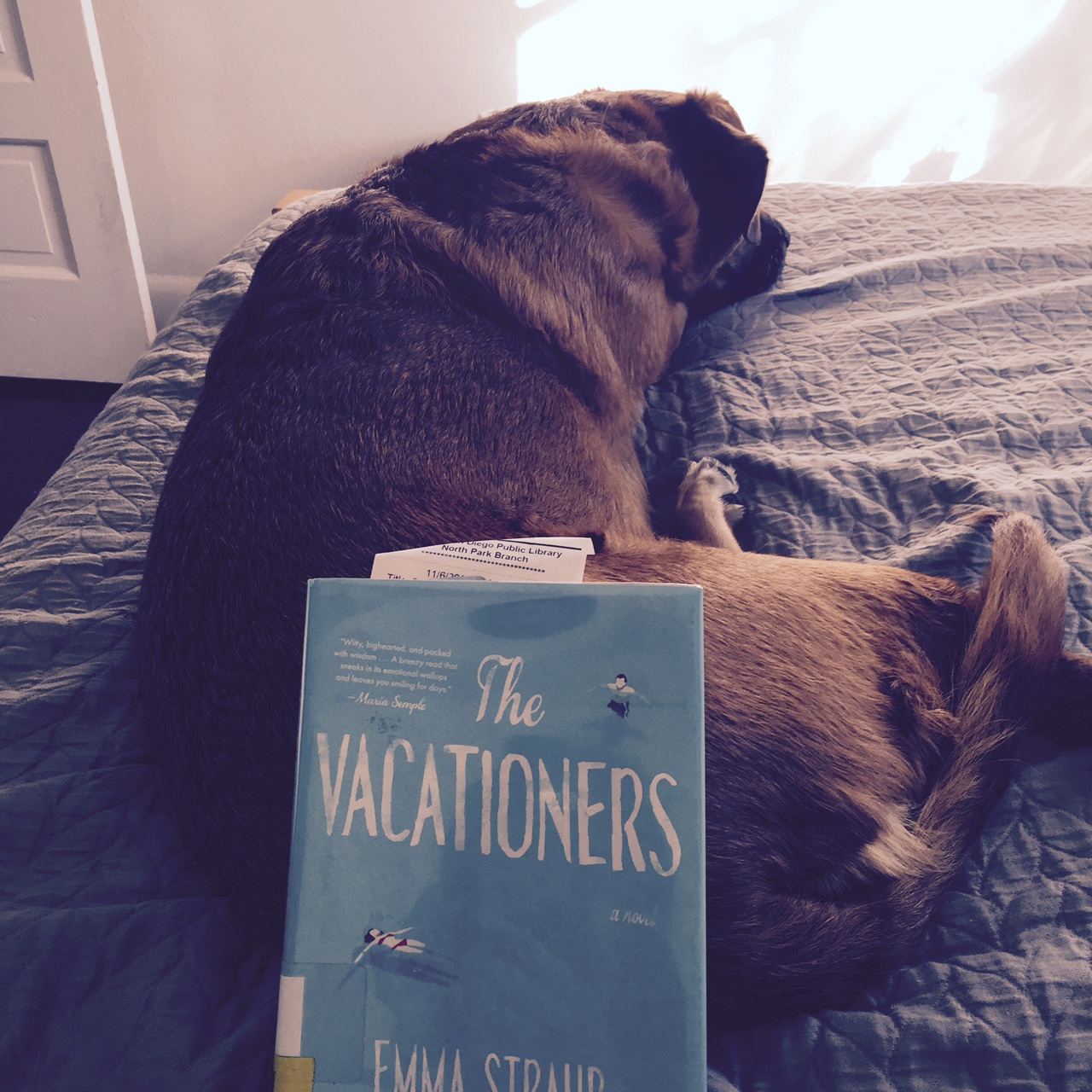
“The Vacationers” by Emma Straub. A dysfunctional family takes a trip to Spain and secrets are revealed.FullSizeRender-2

“Lucky Us” by Amy Bloom. Two half sisters in the 1940’s live an unordinary life. A short, satisfying read.

“Thunderstruck & Other Stories” by Elizabeth McCracken. Perfect, disturbing little short stories. “The grandmother was a bright, cellophane-wrapped hard candy of a person: sweet, but not necessarily what a child wanted.”

Life: Ruby, Story #2

Part One is HERE.

So, we found out Ruby could die if another bee stung her. In our yard we have a huge, beautiful rosemary plant that blooms with purple buds nonstop. Bees love that freaking bush, and it is our nemesis. We rent, believe me, if we owned our house that bush would have been yanked out the minute we found out about the bee allergy. San Diego has blooming flowers, and bees, year round. Avoiding bees can be a full time job…

IMG_1028We were told by multiple vets that the only thing that we could do if Ruby was stung again was to bring her immediately to a vet. That answer made us angry and feel completely helpless. Anaphylaxis can kill in a very short time, and the closest emergency vet, without traffic, is about 15 minutes away.

About 2 months after the bee sting incident I was in a yoga class, and the receptionist came in and whispered to me that my husband was on the phone, and it was an emergency. I ran to the phone and Sean told me to pick him and Ruby up from the park, he thought she’d been stung by a bee because she would not get up. As soon as I arrived, I started breathing easier because I knew that Ruby was not in the middle of anaphylactic shock because she jumped in the car and her tail was wagging.

To be safe and because she was acting a little weird (and Sean still felt really nervous), we took her to the nearest vet, which ended up being total kismet. The vet was about to close, but we explained the situation and they let us in. The calmest, gentlest vet I have ever met listened as I explained to him that we were freaking out taking Ruby outside because of the bees. He fully understood our concerns, and he proceeded to give me an injection kit of epinephrine for Ruby. He measured it out, put it in 2 needles, and then he made me practice giving Ruby an injection. He told us to make sure we carried it everywhere that we went, to always carry gel benadryl tablets (they dissolve faster), and to take a deep breath before doing the injection. I’m not writing the vet’s name down because he is retired now (he retired about a week after we met him, but I’ve emailed with him several times) and because a lot of vets tell you not to use an epipen on your dog.

Having the needles made us a feel a little better. We stopped worrying quite as much. And then, on an early Saturday morning walk, with Ruby smelling like skunk from her run-in a few days before and me jet-lagged from arriving from South Korea the previous night, Ruby lifted up her paw and stopped walking. We were over a mile from our house. We knew almost immediately that she had stepped on a bee because she had a terrified look on her face, and damn it, we did not have the freaking bee kit with us. We debated for about a minute about what to do, and then Sean started running to the house to grab the car and the bee kit.

Once again, I watched Ruby fall apart. Her eyes glazed over, she threw up, and she did not move. Sean runs fast and incredibly he picked us up in about 7 minutes…it felt like forever. I knew I was going to have to inject Ruby with the epinephrine and I braced myself for his arrival. The reason a lot of vets will not give clients epipens is because it can causes paralysis if injected wrong. Scary stuff.

By the time we got Ruby in the car she was almost comatose and barely breathing. Poo started coming out of her (in our brand new car…but whatever), her gums were turning blue, and her eyes were barely open. I thought she was dead. As Sean drove (breaking every traffic rule), I took the scruff of Ru’s neck and injected the vial into her. She gasped, opened her eyes, and I could hear little teeny tiny breaths coming out of her. I tried to stay calm and I repeated over and over that she was a good girl because I did not want her last minutes on Earth to be full of terror and sobs. Once again the emergency vets met us with a stretcher in the parking lot…

I did not think Ruby would make it through this one. I thought they would come out and tell us that she had died. Somehow, the tough little girl survived again.

Most of us have experienced traumatic situations where instinct takes over and things happen in slow motion. The horror and ugliness of the events generally don’t hit until after, and then it is all that you can think about.

Here’s a short list of things that changed after the 2nd bee sting:

  • Always locating the nearest vets before we travel with Ru (and not traveling with her if noIMG_0383 vets are nearby)
  • No more hiking in canyons, trails, or anywhere it would be hard to get a car to
  • Avoid parks where we had previously played fetch (too much clover)
  • Walks before sunrise/after sunset
  • Always walking Ru together so one of us could get the car if needed (she refuses to walk with just one of us now)
  • We tried making Ruby wear booties (not very successful, it made her pretty angry)
  • We did not take Ruby outside if only one of us was at the house
  • Ruby became terrified of things that fly by her (I am sure it is because she watched us freak out)
  • The beach became our safe place
  • Always, always carrying a bee kit and cash in case we had to offer a stranger money to drive us to a vet

We’ve learned from vets that a lot of people euthanize their dogs who have bee reactions like Ruby. Obviously, that option never crossed our minds, but the stress, and the expense of it, is intense.

Part #3, and how we’ve been dealing with the bee allergy coming up…


READ: 2014 Books

I read or listened to over 40 books in 2014, but according to the Best of 2014 Book Lists, I’ve missed a lot of great reads. Check these out if you are trying to decide what to read next (the NPR and Good Read lists also include recommendations for kids and YA):

NY Times 100 Notable Books

Book Riot

NPR

Oprah

Good Reads

Amazon

The Millions: A Year in Reading

Buzzfeed

LA Times

EW

Parnassus Books – great gift guide

The Guardian

I have a lot of reading to do, luckily I have almost 2 weeks off work coming up at the end of December. 2014 books I have on my library hold list include “The Luminaries” by Eleanor Catton (this may be a 2013 book?) , “The Book of Strange New Things” by Michael Faber, “The Vacationers” by Emma Straub, “Landline” by Rainbow Rowell and “The Martian” by Andy Weir. I am also excited to cook from “But I Could Never Go Vegan,” by Kristy Turner, one of my favorite food bloggers. I’ve read the first two books in Jeff Vandermeer’s Southern Reach Trilogy – waiting to blog until I read #three. The trilogy is on most of these lists.

So much good reading this year. My top reads of 2014:

The Bone Clocks – My favorite of the year.

Station Eleven – You WILL like this book. I promise. It is so good.

We are all Completely Besides Ourselves – Powerful, controlled writing about animal rights and family dynamics.

The Oh She Glows Cookbook – I use it at least once a week. Granola recipes in here are the best.

Signature of all Things – Elizabeth Gilbert tops “Eat, Pray, Love” with this one.

The Storied Life of AJ Fikrey – Short, delightful read that bookstore lovers will appreciate. I recommend listening to the audio version.

I am grateful for the San Diego Public Library and the UC San Diego Library. Although, I’ve paid at least $20 in overdue fines this year, they have saved me hundreds of dollars that I would have spent to feed my reading addiction.

And, as always, my favorite presents to give are books. Escaping reality for a few hours truly is an amazing gift.


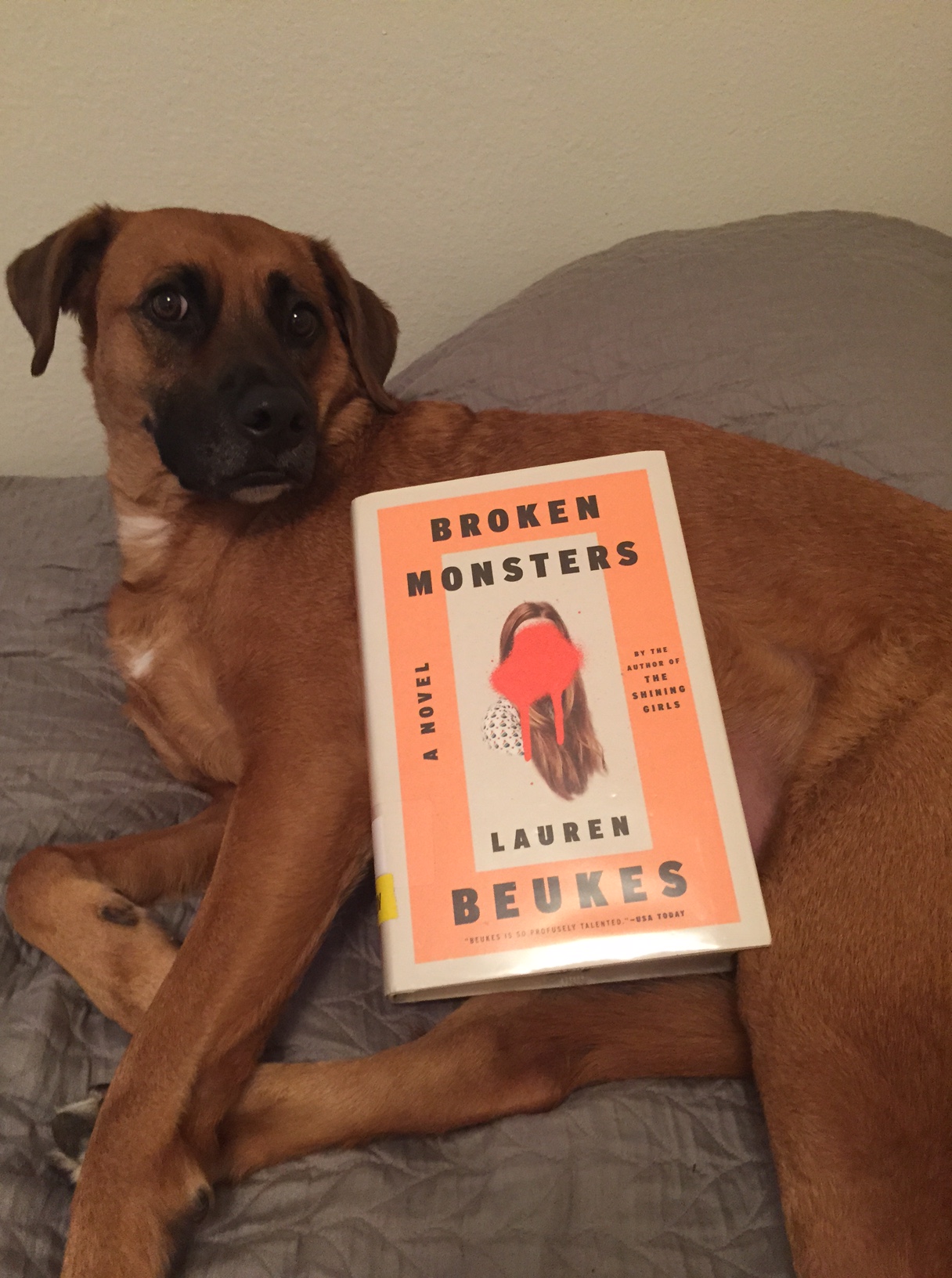
READ: Broken Monsters by Lauren Beukes

I avoid reading horror novels and watching scary movies. I get creeped out easy. Stephen King, Dean Koontz…no thanks. So, I am not sure how I ended up reading Broken Monsters by Lauren Beukes. I must have read an intriguing review somewhere that did not mention the fact that this book induces nightmares and goosebumps and shivers.

In the first chapter a mutilated, murdered boy is discovered by the police department. That alone usually makes me put books aside, but this book takes place in Detroit, and the city of Detroit is the most important character in this book. Beukes, a South African, captures the grittiness and brokenness of Detroit perfectly. That kept me reading, even though there were many times I wanted to stop as the book got darker and darker.

Whenever I tell people where I am from, I say Detroit. That is not exactly true, but a lot of people from the suburbs of Detroit say that. The suburbs I grew up in are 20 miles away from the city, far enough away where we were sheltered from urban crime, homelessness, and extreme poverty. But, with pride, we say we are from Detroit, even though we only went to the city for ball games, coneys, music and shows at the Fox Theater, Eastern Market visits, Greektown Opa, or the Thanksgiving day parade.

As I write this, I have the news on, and the power went out in the city of Detroit today for a few hours. The infrastructure is crumbling. I visit other cities and wonder why Detroit can not get its act together. It is located on a lovely river, beautiful buildings and views, an artistic community…what is missing? Beukes captures the haunting, unique beauty of Detroit with phrases like “In the right light, Detroit’s kinda like the new Bohemia” and “Detroit diamonds, which is what locals call the glass on the street from broken car windows.”

The overall decay of the city serves as a parallel for Beukes’ exploration of things like mental illness, homelessness, poverty, hipsters, graffiti, pedophilia, the pretentious art community, and journalism. Most powerfully, she explores the strangeness and influence of social media. She writes, “Who needs facts when you can go with wild speculation?”

This book is sardonic, dirty, raw, powerful, and shocking. A detective novel, mixed with horror and suspense, mixed with a little dash of magic. I’m glad I read it.

For more on Detroit…I LOVE the Anthony Bourdain Parts Unknown episode about Detroit. He talks about ruin porn and says: “Those who watch this show, smugly thinking, “that could never happen to my city” are dreaming. Detroit’s problems are America’s problems.” See more of the episode here.

IMG_3273